
Your Storage. Your Rules.
Rabbithole doesn't just encrypt your files — it gives you actual ownership of your storage infrastructure. This is fundamentally different from every other cloud storage service.
What makes Rabbithole unique?
When you create storage on Rabbithole, we deploy a personal canister (smart contract) on the Internet Computer blockchain — and then hand you the keys.
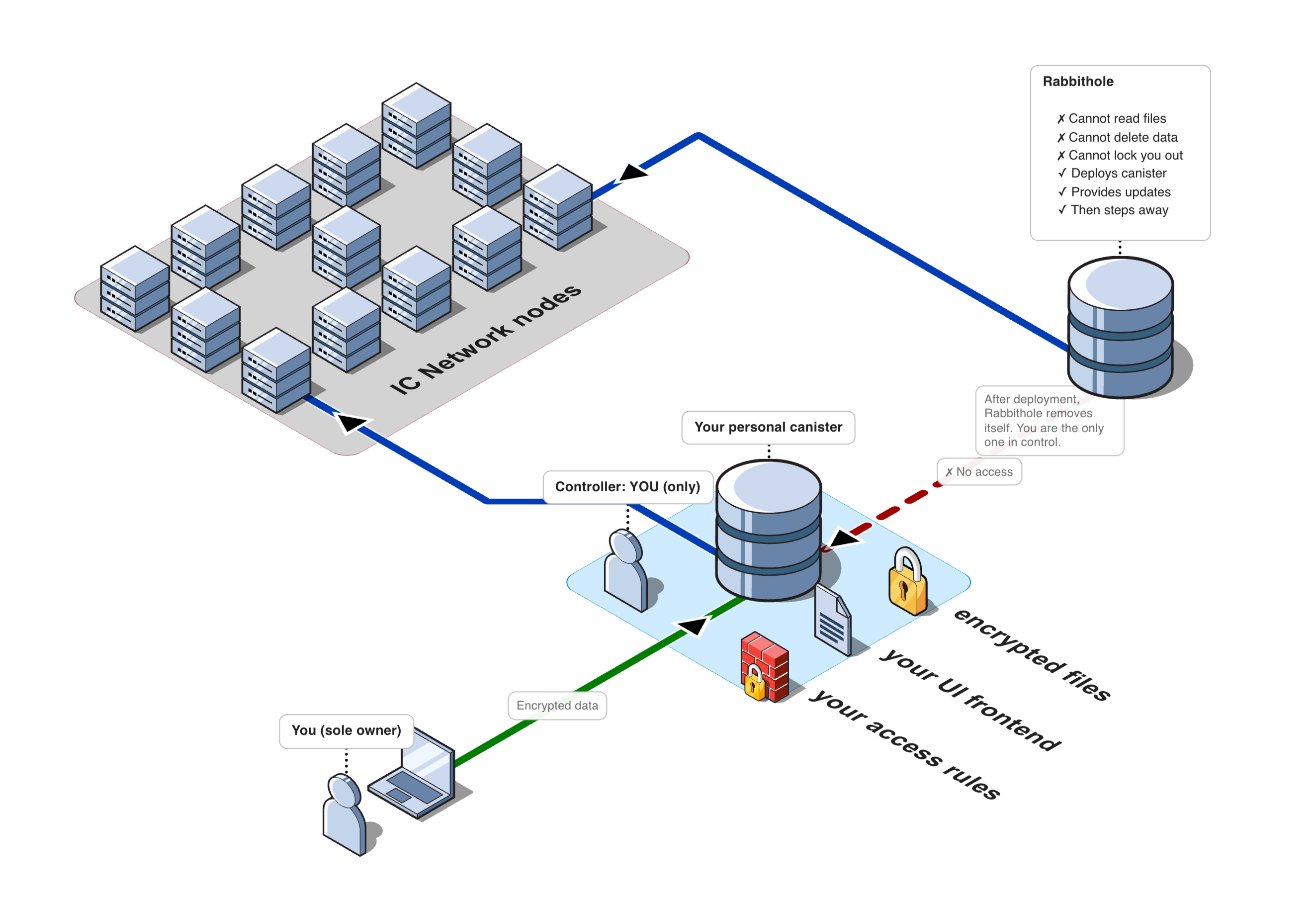
After deployment:
- You are the sole controller of your canister
- Rabbithole removes itself from the list of controllers
- Your canister contains your encrypted files, your frontend UI, and your access rules
- Nobody — not Rabbithole, not any government, not any hacker — can access or delete your data
How your storage is created
Step 1: You pay a fixed price
You pay a fixed price in USD. This covers two things:
- Canister creation — the Internet Computer network charges a fee for creating a new smart contract
- Initial cycles balance — "fuel" your canister needs for computation and storage
Rabbithole does not profit from this step. The entire payment goes to the Internet Computer network. Under the hood, Rabbithole converts your payment to cycles and sends them to the network — but you don't need to think about any of that.
Step 2: Rabbithole deploys your canister
- Creates the canister — at this point, both you and Rabbithole are listed as controllers (Rabbithole needs temporary access to install code)
- Installs the WASM module — the storage canister logic, the same open-source code published on GitHub
- Installs frontend assets — your canister will serve its own web UI
The Rabbithole backend automatically checks GitHub daily for new releases. When a new version is available, it downloads the latest WASM module and frontend assets — so every new canister gets up-to-date code.
Step 3: Rabbithole steps away
After installation, Rabbithole performs a two-step handoff:
- Revokes its own write permission on the canister's asset storage — so it can no longer modify your frontend files
- Removes itself as controller — leaving you as the only controller
From this moment, you are the only one who can manage your canister. This is enforced at the IC protocol level — there is no backdoor.
The result
You can access your storage in two ways:
- Through rabbithole.app — the main application interface
- Directly at https://<canisterId>.icp0.io — your canister serves its own frontend
Your identity (Principal ID) is the same in both cases — Rabbithole uses a key delegation mechanism so that Internet Identity recognizes you regardless of which URL you use. Read more on the Authentication page.
What if Rabbithole disappears?
This is the question nobody asks about Google Drive — because the answer is terrifying. With Rabbithole, it's simple: nothing changes for your data.
Your canister is a fully autonomous smart contract on the Internet Computer. Rabbithole.app is just a convenient way to interact with it — but it's not the only way and not a requirement.
- Your data stays on the Internet Computer blockchain — the canister keeps running independently
- You access it directly at
https://<canisterId>.icp0.io— your canister already serves its own frontend - You top up cycles directly through the IC management interface, without Rabbithole
- The code is verifiable — all WASM modules and frontend assets are open source. You can verify that the module installed in your canister matches the published release by comparing SHA-256 hashes:
dfx canister info <id> --network icreturns the module hash - Updates are optional — your canister works fine without ever being updated
Rabbithole is designed so that its own disappearance doesn't affect your data or access to it. Your canister is self-sufficient from the moment it's created.
How does controller transfer work?
The handoff is a two-step process:
- Revoke
#Commitpermission — Rabbithole callsrevoke_permissionon the http-assets interface of your canister, removing its ability to write or modify frontend files. - Remove as controller — Rabbithole calls
IC.update_settingswithcontrollers = [your_principal], removing itself entirely. Only your Principal remains.
The Internet Computer's management canister enforces controller rules at the protocol level — once Rabbithole is removed, there is no backdoor, no admin access, no override mechanism. The IC consensus protocol guarantees this.
You can verify your canister's controllers at any time:
What about canister upgrades?
Rabbithole has a built-in update delivery mechanism. When a new version is available, you see a notification banner in the interface. The update process works like this:
- You decide — updates are never forced. You see a banner and choose whether to update
- Temporary access — if you agree, Rabbithole is temporarily added as a controller of your canister
- Update — Rabbithole installs the new WASM module and/or frontend assets
- Access removed — Rabbithole removes itself as controller again
Snapshots for safety: Before any update, you can take a snapshot of your canister's state through the interface. A snapshot captures the current Stable Memory and WASM module. If something goes wrong after an update, you can roll back to the snapshot — restoring your data and code to the exact state before the update.
Your data is stored in Stable Memory — persistent storage that survives code upgrades. Even if you upgrade the canister's logic, your files remain intact.